
Psychedelics Blog
Psilocybin and Brain Circuits: What New Imaging Research May Reveal About Psychedelic Mushrooms
Oct
Psilocybin mushrooms have moved from the margins of scientific discussion into a growing field of neuroscience research. As interest in psychedelic mushrooms increases, researchers are using brain scans, controlled experiments, and clinical studies to investigate what happens in the brain during and after a psychedelic experience.
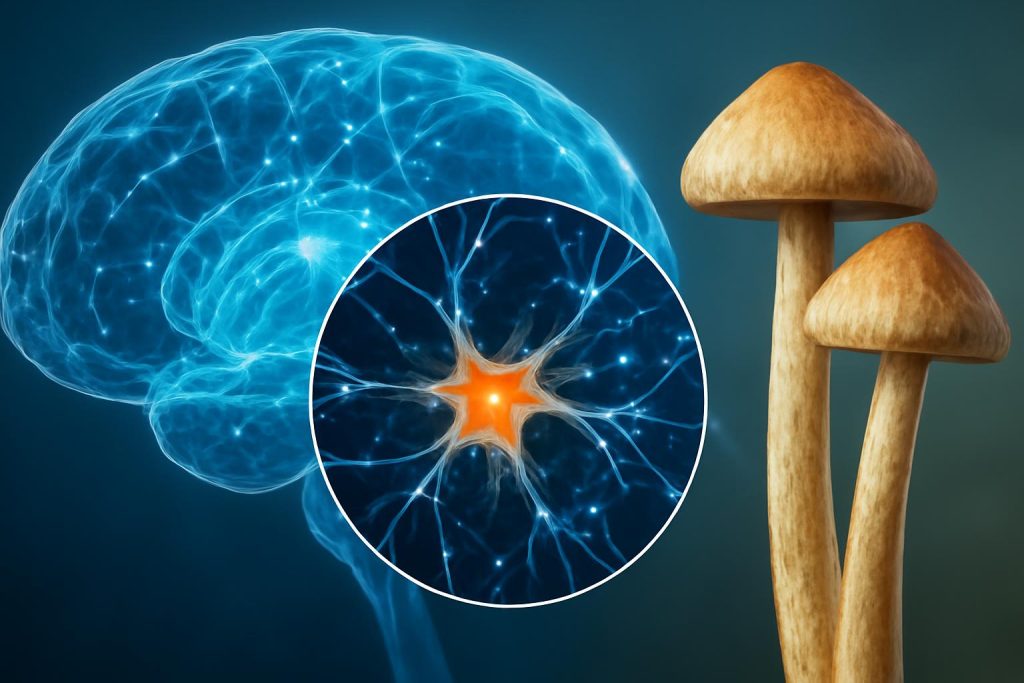
One of the most closely watched questions is how psilocybin affects communication between brain circuits. Early findings suggest that psilocybin may temporarily change the way brain networks coordinate, reducing some habitual patterns while increasing communication between regions that do not usually interact as strongly. These observations may help explain why people report changes in perception, emotion, self-reflection, and their sense of connection.
However, brain imaging findings are not proof that magic mushrooms treat a particular condition, permanently “rewire” the brain, or are appropriate for everyone. The research is promising but still developing. Understanding the difference between a compelling scientific signal and a proven medical benefit is essential for anyone exploring psilocybin research.
What does psilocybin do in the brain?
Psilocybin is a naturally occurring psychedelic compound found in certain fungi. After ingestion, the body converts it into psilocin, the compound primarily associated with psychedelic effects. Psilocin interacts with several serotonin receptors, including the 5-HT2A receptor, which is widely distributed in areas involved in perception, attention, mood, and cognition.
This receptor activity does not act like a simple on-and-off switch. Instead, it can influence how information is filtered and integrated across the brain. During a psychedelic experience, ordinary patterns of attention and interpretation may become less rigid. Sensory input can feel unusually vivid, while thoughts, memories, and emotions may take on new associations.
Scientists often describe these changes in terms of brain networks or circuits. A network is a group of connected brain regions that work together for certain functions. Examples include networks involved in self-referential thinking, executive control, salience detection, memory, and sensory processing.
Why brain circuits matter in psychedelic research
Many everyday mental processes rely on familiar patterns. People tend to revisit the same worries, assumptions, habits, and interpretations. These patterns are not always harmful, but they can become inflexible. Researchers are investigating whether psilocybin temporarily changes the balance between stable network activity and more flexible communication.
Brain imaging studies can examine this question in several ways:
- Functional MRI: Measures changes in blood flow associated with brain activity while a person is resting or completing a task.
- Connectivity analysis: Estimates how closely the activity of different brain regions changes together.
- Electroencephalography: Records electrical activity through sensors placed on the scalp.
- Longitudinal imaging: Compares brain activity before, during, and after an intervention.
Each method offers a different perspective. A scan may show that two regions communicate differently during a psychedelic state, but that does not automatically explain why the change occurs or whether it will last. It also cannot, by itself, establish that a particular brain pattern caused a person’s emotional or behavioral outcome.
What recent imaging findings may suggest
Recent coverage of psilocybin neuroscience has focused on an apparent paradox: psychedelic states can look disorganized in some ways while showing signs of coordinated activity in others. Researchers may observe less predictable communication within certain established networks alongside increased communication between networks that are usually more separated.
This pattern is sometimes described as greater flexibility or reduced network constraint. In practical terms, the brain may become less governed by its usual divisions for a period of time. Areas involved in sensory processing, memory, emotion, and self-related thought may exchange information in unfamiliar combinations.
That interpretation could help explain several commonly reported psilocybin effects, including:
- Changes in the perceived meaning or emotional quality of memories
- Altered time perception and sensory intensity
- A temporary loosening of rigid self-narratives
- Unexpected associations between ideas, images, or feelings
- A heightened sense of connectedness or significance
These experiences are not uniformly positive. The same reduction in ordinary psychological control can feel liberating in a supportive setting but frightening or destabilizing in an unsafe environment. Set, setting, personal history, expectations, and the presence of trained support can all influence how an experience unfolds.
Does psilocybin permanently rewire the brain?
“Rewiring” is a popular term, but it can oversimplify the science. Some laboratory research suggests that psychedelic compounds may influence processes related to neural plasticity, including the formation or strengthening of connections between nerve cells. Other studies have examined changes in brain network activity after the acute effects have ended.
Still, several important questions remain open. Researchers are working to determine which changes are temporary, which may persist, and which are related to meaningful improvements in daily functioning. A measurable change on a scan is not necessarily beneficial, and a lack of a visible change does not mean that a person experienced no psychological effect.
It is also difficult to separate the direct pharmacological effects of psilocybin from the broader therapeutic context. In clinical research, preparation, supervision, psychological support, and follow-up may contribute substantially to outcomes. The drug is only one part of the intervention.
For readers interested in the broader subject, our mushroom education library provides a place to explore additional site content as it becomes available.
How brain imaging connects to reported psychedelic effects
Changes in self-focused thinking
Some imaging research examines brain systems associated with self-referential processing. These systems help people reflect on their identity, personal history, and future. Under psilocybin, activity or coordination within these systems may change, which researchers have connected with reports of reduced self-focus or a temporary shift in personal identity.
This does not mean that psilocybin eliminates the self or produces the same experience for every person. Descriptions range from peaceful detachment to confusion, emotional intensity, or fear. Individual responses can vary considerably.
Greater communication between networks
Ordinarily, different brain networks tend to specialize in related tasks. Psilocybin may increase communication across some of these boundaries. Researchers are interested in whether this flexibility could help explain changes in creative thinking, emotional insight, or the ability to view a problem from a different perspective.
Claims about creativity should be interpreted carefully. A person may feel more imaginative during a psychedelic experience without necessarily producing more useful ideas or making better decisions. Objective testing is needed to determine when subjective inspiration translates into measurable performance.
Emotion and memory processing
Psilocybin can bring emotionally meaningful memories or concerns into awareness. Brain circuits involved in emotion and memory may interact differently during the experience, potentially changing how a person relates to familiar thoughts.
This can be psychologically significant, but it can also be challenging. Difficult memories may surface unexpectedly. People with a history of trauma, severe anxiety, or other mental health concerns should not assume that a psychedelic experience is a safe substitute for professional care.
What brain imaging research cannot yet tell us
Brain scans are valuable research tools, but they have limits. A scan shows patterns of activity or connectivity; it does not read thoughts or provide a complete explanation of consciousness. Researchers must interpret imaging results alongside clinical outcomes, behavioral measures, participant reports, and long-term follow-up.
Several limitations are especially important:
- Small samples: Early psychedelic studies often include relatively few participants, which can make results less precise.
- Expectation effects: Participants may have strong beliefs about psilocybin, influencing how they report their experience.
- Difficulty with blinding: The noticeable effects of psychedelics can make it difficult for participants and researchers to remain unaware of who received the active compound.
- Different products: Mushroom species, cultivation conditions, storage, and preparation can affect the amount of psilocybin present.
- Short follow-up periods: A study may identify changes days or weeks after an experience without establishing long-term effects.
These limitations do not invalidate the research. They show why individual studies should be viewed as part of a larger evidence base rather than as final answers.
What this means for people interested in magic mushrooms
For consumers, the most practical lesson is that psilocybin effects are not determined solely by a label such as Golden Teacher, Penis Envy, or another commonly marketed name. Potency can vary between samples, and the psychological environment matters greatly. A familiar strain name does not guarantee a predictable experience.
People should also distinguish between educational information and medical treatment. Psilocybin remains federally controlled in the United States, while state and local laws vary. Rules may differ for possession, cultivation, services, research, and supervised programs. Anyone considering mushroom products should review current laws in their jurisdiction.
Our mushroom topic directory can help readers navigate future educational categories, but online information should never replace advice from a licensed healthcare professional.
Important safety considerations
Psilocybin is not risk-free. Possible short-term effects include anxiety, panic, confusion, nausea, impaired judgment, increased heart rate, and changes in coordination. A difficult experience may be more likely when someone is already distressed, uses an uncertain product, combines substances, or is in an uncontrolled setting.
Extra caution is warranted for people with a personal or family history of psychotic disorders, bipolar disorder, or mania. Interactions with prescription medications and other substances may also be relevant. Anyone taking psychiatric medication or managing a serious medical condition should speak with a qualified clinician before making decisions about psychedelic substances.
Never drive, operate equipment, swim, climb, or make important decisions while experiencing psychedelic effects. If someone develops severe agitation, chest pain, seizures, difficulty breathing, extreme confusion, or appears to be a danger to themselves or others, seek emergency medical help.
Where psilocybin brain research may go next
The next phase of research will likely combine brain imaging with more detailed measures of behavior, mood, sleep, stress, and daily functioning. Scientists may also investigate whether brain changes differ according to dose, therapeutic support, personal history, and the timing of follow-up.
Researchers are particularly interested in identifying reliable markers. If a specific pattern of brain activity consistently predicts who benefits, who experiences adverse effects, or who needs additional support, it could improve future study design and clinical safety. That goal remains experimental rather than established.
Future work may also clarify whether psychedelic effects are best understood as a temporary change in brain network flexibility, a catalyst for learning in a supportive environment, or a combination of biological and psychological processes. The answer may not be the same for every person or every condition.
Frequently asked questions
What are psilocybin brain circuits?
The phrase refers to connected groups of brain regions whose activity may be influenced by psilocybin. Researchers study circuits involved in perception, attention, emotion, memory, self-related thinking, and decision-making.
Can psilocybin change brain connectivity?
Imaging studies suggest that psilocybin can alter functional connectivity during the acute psychedelic state, including communication within and between large-scale brain networks. The meaning and duration of these changes are still being investigated.
Does increased brain connectivity mean better brain function?
Not necessarily. More connectivity is not automatically healthier or more useful. The value of a change depends on which regions are involved, when it occurs, how long it lasts, and whether it is associated with improved functioning.
Are psychedelic mushrooms a proven treatment?
Psilocybin-assisted therapy is an active area of research, but research findings do not mean that nonclinical mushroom use is an approved treatment. Anyone seeking help for depression, addiction, anxiety, or another condition should consult a qualified healthcare professional.
Where can I learn more about mushrooms?
You can visit the Healing Mushrooms Delivery homepage for site updates and educational information. Always verify product details, follow applicable laws, and approach claims about magic mushrooms with careful attention to evidence and safety.
The bottom line
Emerging research suggests that psilocybin may temporarily change how brain circuits communicate, making ordinary network boundaries less rigid and allowing unusual patterns of information exchange. These findings offer a plausible biological framework for altered perception, emotional intensity, and shifts in self-related thinking.
They do not prove that psilocybin permanently rewires the brain, guarantees personal growth, or is safe for everyone. The science is developing, and responsible interpretation requires attention to study design, individual risk, legal status, and the difference between a supervised clinical protocol and unsupervised use.
